
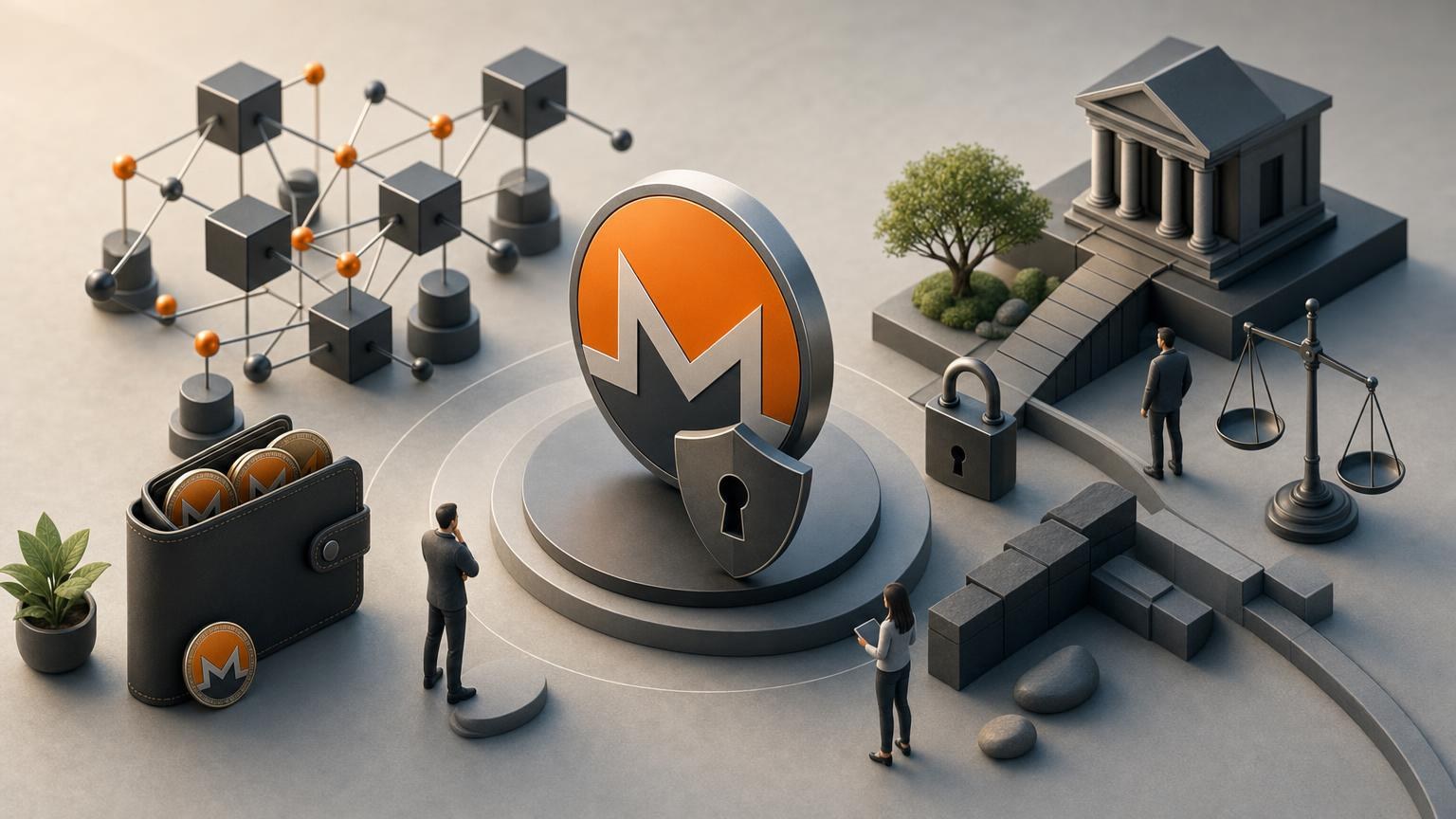
Monero provides privacy at the blockchain protocol level: its standard transactions conceal the recipient, transferred amount and actual spent output from ordinary public inspection. That is a stronger starting point than optional privacy, but it is not a guarantee that every participant, device, service or network connection will remain anonymous. Safe XMR use requires separating on-chain protection from operational security, counterparty knowledge and legal obligations.
Claim Verification Protocol
Monero provides default on-chain privacy, not universal anonymity
- Correct formulation
- Monero uses stealth addresses, Ring Confidential Transactions and ring signatures to protect transaction details on its blockchain. These mechanisms respectively conceal the recipient, amount and actual spent output from ordinary observers. Monero’s technical specification describes sender privacy as probabilistic, while recipient and amount privacy receive stronger assurances. [1]
- Verdict on the simplified claim
- Misleading.
- Claim being tested
- “Using XMR makes a person completely anonymous in every situation.”
- Why the simplification appears
- Descriptions of Monero often focus on what an outside observer cannot read directly from the blockchain. That narrower technical property can be mistaken for protection across the entire payment process.
- Damage caused by the error
- A user may disclose identifying information to a merchant, exchange or counterparty while assuming the protocol will erase that connection. Account records, messages, delivery details, device compromise and voluntarily disclosed keys remain outside the protection supplied by Monero’s transaction cryptography. The official Monero FAQ explicitly warns that counterparties do not forget personal information merely because payment was made in XMR. [2]
- How to verify
- Compare the Monero technical specification’s separate sections for sender, recipient, amount and IP-address privacy. If a privacy promise does not identify which layer it covers, treat it as incomplete.
- Practical conclusion
- Use “private on-chain transaction” as the baseline description. Assess identity exposure, communications, wallet security and network metadata separately before sending funds.
Monero does not automatically hide a wallet’s network connection
- Correct formulation
- A wallet connected directly to an external remote node does not receive IP protection by default. A remote node cannot simply take the wallet’s private keys, but its operator may observe connection information and associate metadata such as an IP address and transaction activity. Running a personal node reduces reliance on an external operator; Tor or I2P can be used when additional network-layer privacy is required. [1]
- Verdict on the simplified claim
- Misleading.
- Claim being tested
- “Monero hides the sender’s IP address automatically.”
- Why the simplification appears
- On-chain sender privacy and internet-connection privacy are both described with the word “privacy,” although they address different data. Ring signatures operate on transaction inputs; they do not make a wallet’s network route disappear.
- Damage caused by the error
- A privacy-sensitive user may connect repeatedly to an unknown public node without considering what its operator can log. Even when the destination and amount remain concealed on-chain, network observations may narrow the context around a transaction.
- How to verify
- Open the wallet’s node settings and determine whether it uses a local node, a trusted remote node or an unknown public node. Then check whether the connection is routed through an anonymity network. Monero’s network documentation cautions that untrusted nodes and explorers may log IP addresses, transaction IDs and related metadata. [3]
- Practical conclusion
- Choose the node model deliberately. Convenience may justify a remote node for some users, but it should not be confused with the stronger trust model of a personal node.
Subaddresses reduce address-based linking but do not erase service records
- Correct formulation
- A fresh subaddress can help prevent a payer from easily recognising the same receiving address in later payments. Monero documentation recommends subaddresses as the default receiving format. However, a service can still link withdrawals or payments inside its own database when they belong to the same account or identified customer. [4]
- Verdict on the simplified claim
- Context-dependent.
- Claim being tested
- “A new subaddress makes separate payments impossible to associate.”
- Why the simplification appears
- Generating a new subaddress is an easy, visible privacy step. Its limitations are less obvious because the relevant links may exist off-chain rather than in the address itself.
- Damage caused by the error
- A business may assume that changing receiving addresses separates customers, orders or internal activities in every system. A user may also combine funds in ways that reveal relationships to a particular sender. Monero’s subaddress documentation warns that sweeping balances from multiple subaddresses together can link them in a specific privacy scenario. [4]
- How to verify
- Check the receiving address type in the wallet and review who already knows the account owner. A new subaddress changes the public destination supplied for a payment; it does not delete login records, invoices, support messages or prior identity checks.
- Practical conclusion
- Generate a distinct subaddress for a distinct expected payment when the wallet and counterparty support it. Keep internal labels locally, and do not treat address rotation as a substitute for broader data minimisation.
Private transactions can still support payment verification
- Correct formulation
- Monero wallets provide transaction and spend proofs that can help demonstrate that a payment was made without turning every transaction detail into a publicly readable blockchain record. Verification requires the relevant transaction data and proof material. Monero’s wallet documentation also cautions that a transaction proof alone does not guarantee that associated funds remain spendable. [5]
- Verdict on the simplified claim
- Misleading.
- Claim being tested
- “Because Monero is private, a sender can never prove payment.”
- Why the simplification appears
- On transparent blockchains, people often use a block explorer as a universal receipt. Since a Monero explorer does not publicly reveal the same destination and amount information, the absence of that familiar method may be mistaken for an absence of any verification method.
- Damage caused by the error
- A payer may disclose excessive wallet information during a dispute or share sensitive keys without understanding their scope. At the other extreme, a recipient may reject a valid proof simply because an ordinary explorer cannot display the full payment details.
- How to verify
- Consult the current official wallet reference for the supported proof commands and their warnings. Distinguish a transaction ID, a transaction proof, a transaction private key, a view key and a spend key before sharing anything. They do not grant the same visibility or authority.
- Practical conclusion
- Agree on a payment reference and dispute procedure before a material transfer. Share only the minimum proof needed for the specific payment, never the wallet seed or private spend key.
Protocol privacy does not remove exchange or compliance requirements
- Correct formulation
- Whether XMR can be bought, sold, deposited or withdrawn depends on the provider, direction, jurisdiction, customer location and compliance assessment. A service may request information even when the underlying blockchain transaction is private. Regulatory obligations for virtual-asset activity can include customer due diligence, sanctions controls and recordkeeping, with rules differing across countries. U.S. OFAC guidance, for example, states that sanctions obligations apply to virtual-currency transactions as they do to traditional-currency transactions, while EU guidance applies a risk-based AML framework to crypto-asset service providers. [6]
- Verdict on the simplified claim
- Confirmed only as a context-dependent limitation.
- Claim being tested
- “An XMR exchange never requires identity or source-of-funds checks.”
- Why the simplification appears
- Monero has no central protocol operator that opens an account for a blockchain address. A commercial exchange, however, is a separate organisation with its own legal duties, risk controls and transaction policies.
- Damage caused by the error
- A customer may create a time-sensitive transaction without reviewing eligibility, required documents or refund conditions. This can lead to delays, rejection or a compliance review. Privacy features also do not exempt anyone from sanctions, tax, reporting or other applicable rules.
- How to verify
- Before creating an order, check the provider’s current XMR direction, supported network, destination requirements, customer restrictions and verification terms. For legal questions, consult the relevant regulator or a qualified professional in the applicable jurisdiction rather than relying on a generic cryptocurrency article.
- Practical conclusion
- Assume that checks may vary by transaction direction and the result of compliance screening. Do not send XMR until the actual order displays a supported route and you understand what may be requested.
Where the Honest Answer Depends on Context
How private is a particular payment? The protocol supplies default on-chain protections, but the practical answer depends on who knows the payer or recipient, which node is used, what information was exchanged outside the blockchain and whether the device is secure. A face-to-face transfer between self-hosted wallets has a different metadata profile from a withdrawal made through an identified online account.
Should every recipient use a subaddress? For individuals, Monero documentation generally recommends subaddresses. Automated businesses may sometimes use integrated addresses because they contain an encrypted payment identifier that helps match a transfer to an order. The correct format therefore depends on what the receiving system explicitly supports; a sender should use the exact address generated for the transaction rather than converting or editing it. [7]
Is a remote node acceptable? That depends on the threat model. A remote node can improve convenience and cannot spend funds without the wallet’s private spend authority, but it introduces privacy and reliability considerations. A personal node removes that particular third-party dependency, while network routing choices determine whether an internet provider or first-hop service can observe the connection. [1]
Will an exchange request verification? There is no honest universal answer. Requirements can change with the route, amount, customer profile, jurisdiction and compliance findings. Even when a provider supports XMR as an asset, that does not prove that every pair, network or direction is currently available.
Checking Exchange Conditions Before Sending XMR
The exchange service described here supports XMR among its listed assets, but availability of a specific pair or direction must be confirmed for the intended operation. Use the order interface to check the current XMR exchange conditions, including the displayed receiving asset, network, address format and any verification requirements, before transferring funds. Do not infer support for an unlisted route from general XMR support.
A planned ruble bank-card conversion feature should not be treated as available. No XMR purchase or sale should be initiated on the assumption that card-to-ruble or ruble-to-card settlement already works, and no launch date should be inferred.
Safety Checklist for Risks Outside the Privacy Protocol
- Obtain wallet software from the project’s recognised distribution channel and verify it before use. Monero’s official procedure calls for checking the signature on the published hash list and comparing the downloaded archive’s hash before extracting it. This helps detect a substituted or modified wallet package. [8]
- Protect the recovery seed offline. Anyone who obtains the seed or private spend key can control the wallet. A wallet password protects the local wallet file but does not replace secure seed storage. Never enter recovery words into a website reached through an advertisement, unsolicited message or support chat.
- Validate the complete destination. Confirm the first and last characters, then compare the full address through an independent channel when possible. Monero addresses contain a checksum that wallet software can validate, but a checksum cannot tell whether a valid address belongs to the intended recipient. The wallet can also identify whether an address belongs to mainnet, stagenet or testnet. [9]
- Confirm the asset and network on both sides. “XMR supported” is not enough if the receiving service has paused deposits, requires a particular address type or does not offer the intended direction. Never send another asset to a Monero address or assume that similarly named networks are interchangeable.
- Review the order while it is still active. Copy the address and required amount from the current order rather than from an old email, browser history or previous transaction. Malware can replace clipboard contents, so compare what the wallet displays before authorising the transfer.
- Use a small validation transfer when the recipient and current conditions permit it. Cryptocurrency transfers are not reversible, so an initial transfer can reduce the consequence of an address, workflow or account-assignment error. It does not eliminate exchange-rate movement, fees or compliance risk. [10]
- Allow for volatility without making a price prediction. The value of XMR relative to fiat currencies and other crypto-assets can change while an operation is being prepared. Check the actual order terms when ready to transact and decide whether the displayed conditions remain acceptable.
- Preserve the transaction record without publishing sensitive material. Store the order identifier, destination, amount, transaction ID and relevant correspondence. Keep seeds, private spend keys and unnecessary wallet-wide disclosure data out of screenshots and support messages.
A Responsible Working Model for XMR
Treat Monero as a cryptocurrency with built-in on-chain privacy, not as an invisibility tool. Start by identifying the information protected by the protocol, then map what remains visible to the counterparty, exchange, node operator, device and network provider. Verify the exact address and exchange route, disclose only narrowly scoped proof when needed, and expect legal or compliance conditions to depend on the jurisdiction and transaction context. If any destination, network or requirement remains ambiguous, pause before broadcasting the irreversible transfer.